|
The most consequential shopper a consumer brand will serve this decade may be an algorithm, buying on a human’s behalf. Across consumer-packaged goods, discovery, comparison and the transaction are increasingly using artificial intelligence (AI), and most organizations have no single leader who owns the AI-mediated path to purchase. The relocation is already measurable. When large language models (LLMs) cite sources about a brand, only one percent come from the brand’s own website.¹ Increasingly, the narrative used by LLMs is assembled where the company holds no direct control. The storefront has quietly moved upstream, into the model. |
A Data Problem Before a Marketing One
Visibility now depends on whether a company’s data can be read and trusted by a machine. The instinct is to treat visibility as a marketing challenge; however, it is an infrastructure problem first. AI agents act on structured, machine-readable data, and they act fast. When a company’s product, pricing and availability information is incomplete or inconsistent, the agent does not pause to investigate. Imagine an AI assistant asked to assemble a weekly grocery order or the ingredients for a single recipe. It will build the cart from products whose price and availability it can read cleanly and silently omit the ones it cannot. A brand can lose the sale without a single person having rejected it.
The discipline emerging around this problem is called generative engine optimization. In practice, it means keeping product data clean and current enough for a model to use. The stakes are not marginal. Traffic referred by AI converts roughly 42 percent better than traditional search;² therefore, brands cannot afford to miss these shoppers.
The Insight a Brand Can No Longer See
There is a second, quieter cost, and it is one leadership teams tend to notice too late. As shopping moves inside AI, the brand can no longer see how consumers first discover and consider it. When a consumer researches a category, weighs options and forms a preference entirely within an agent, they only surface on the retailer’s site at the moment of checkout. Everything upstream happens beyond the brand’s view and organizations lose the shopper data that once told them what to make and how to price it. This is not a reporting inconvenience. It erodes the consumer insight that guides the entire business.
Closing this divide starts with infrastructure, and that is where good intentions usually stall. The machine-readable foundation these agents require (clean and consistent product data exposed in real time) rarely wins the budget fight. Industry analyses estimate that simply keeping legacy systems running can consume roughly a third of IT spending, which is often why the data groundwork never gets built and AI pilots stay stranded in the test phase.
The Unowned Leadership Seat
Ownership of the AI-driven path to purchase spans commercial strategy, data, technology and brand, so it tends to fall between the established seats rather than into any one of them. It belongs to a leader fluent in both the commercial and the technical, a profile most often titled Chief AI Officer. The same imperative is now visible well beyond consumer goods, reshaping leadership in sectors from insurance to distribution.
Regardless of title, filling the seat is where organizations struggle. The resume that signals technical credibility rarely signals commercial judgment, and the two seldom arrive in equal measure. A technologist builds the machine-readable foundation but cannot always convert it into pricing, assortment and margin decisions. A commercial leader owns the profit and loss (P&L) but underestimates the data infrastructure on which the role depends. The rare hire holds both.
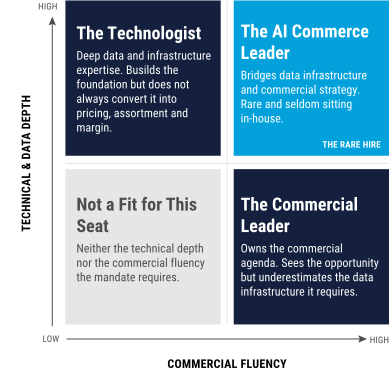
Since that combination rarely appears on a resume, many companies misidentify the profile they actually need. Technical expertise is relatively easy to recognize. Commercial judgment is equally recognizable. The ability to translate AI into pricing decisions, assortment strategy, retailer relationships and profitable growth is far harder. Organizations that hire for only one side of the equation often discover too late that they have filled the role without solving the problem.
Evaluating these leaders requires looking beyond technical credentials or functional pedigree. The most effective executives consistently demonstrate four capabilities: the commercial fluency to connect AI initiatives to revenue and margin; the data and infrastructure literacy to build the machine-readable foundation AI depends on; the cross-functional influence to lead across marketing, commerce and technology; and the builder’s mindset to create entirely new capabilities rather than simply optimize existing ones. Just as importantly, the weighting of those capabilities differs from company to company. A business modernizing its technology stack requires a different leader than one scaling AI-enabled commerce across an established digital ecosystem.
The search for this leader often begins in the wrong place as well. Boards naturally look across competing consumer brands, assuming the experience they need already exists within the category. Increasingly, it does not. Many of the executives who have already built AI-enabled commerce developed those capabilities in technology platforms, marketplaces, retail media networks, enterprise software companies and digitally native retailers where machine-readable product data, recommendation engines and AI-assisted purchasing are already core operating capabilities. The strongest candidate may understand consumers exceptionally well without having spent much of their career in consumer-packaged goods.
The real challenge becomes identifying the executive who has already lived in the industry’s future.
The Early Movers Are Already AheadDuring the 2025 holiday season, retailers with AI-agent integration saw roughly seven times the sales growth compared to those who lacked it,³ in a channel on track to approach 190 billion dollars in the United States by 2030.⁴ Brand equity and distribution built the last era of consumer goods, but the next advantage will belong to the companies that put the right leader in this seat before their competitors recognize it exists. The next generation will be defined by whether algorithms can discover, understand and recommend those brands. That shift will be led by executives who can connect data, AI and commercial strategy into sustainable competitive advantage. The companies identifying those leaders today will be the ones setting the pace tomorrow. |
SOURCES
(1) McKinsey, State of the Consumer 2026 | (2) Adobe Analytics, 2026 | (3) Salesforce, 2025 | (4) Morgan Stanley, 2025
Related Insights
Contributor